
Secondary Applications
Secondary applications are institution-specific components of the admissions process that occur after submission of the primary application. Requirements vary by health profession and school but commonly include supplemental fees, letters of evaluation, additional essay questions, and situational judgment assessments.
These materials allow admissions committees to gain a deeper understanding of applicants beyond what is included in the primary application.
Learn more about the purpose of secondary applications and how they fit into the overall application process by watching the video below:
After submitting your primary application, secondary applications are distributed by individual programs on their own timelines, often throughout the early summer months of the application cycle.
Secondary applications are often delivered directly to the email address associated with your application service account, so it is important to monitor your inbox regularly and check your spam or junk folders to avoid missing communications. Aim to submit secondary applications within two to three weeks of receiving them.
For some application services, particularly those using LiaisonCAS platforms, secondary application requirements may instead be embedded within the application itself under the “Program Materials” section. Aim to complete “Program Materials” within three weeks of your initial primary application submission.
These timelines should take precedence over the official application deadline whenever possible. Remember, without a completed secondary application, you are unlikely to receive an interview invitation!
It is also important to recognize that secondary applications are not always sent automatically to every applicant. Each institution establishes its own screening process, timeline, and criteria for distributing secondary applications, and some schools may choose not to invite certain applicants to complete a secondary application.
Strategies for staying organized
Keep a spreadsheet:
Use your personal or the PreMed & PreHealth School List Builder Template to organize your schools and secondary applications. Remember to complete all necessary elements of the school’s secondary application process (e.g., fees, tests, etc.). Consider adding columns for:
- Pre-written essays
- Date secondary received
- Date secondary submitted
- Additional requirements (Situational Judgement Tests, fees, etc.)
Establish Priority:
Submit your secondaries based on the priority you give to each of your prospective schools.
Within each priority tier (top, middle, last), you can prioritize by anticipated time it will take you to complete (e.g., if a school has few or no questions), but make sure you do your top priority schools first!
Many health professional programs charge a secondary application fee, though the amount varies by institution.
Fees can range from approximately $30 to $250, with most falling near $100 per school. Because secondary fees are assessed separately by each program, applicants should budget accordingly when applying to multiple institutions.
Applicants who receive fee assistance through a centralized application service, such as AMCAS, AACOMAS, or AADSAS, may also qualify for secondary application fee waivers. While policies vary by institution, many programs voluntarily waive secondary fees for applicants who have been approved for fee assistance through their primary application service. Applicants should review each school’s fee waiver policies and instructions carefully.
Letters of evaluation, whether submitted individually or through a Letter Packet, are generally considered part of the secondary application process, even though they are uploaded through the centralized application service.
You do not need to wait for your letters to be submitted before submitting your primary application. Submit your primary application and enter the verification queue while your letters are still being collected. Admissions committees typically review letters after a secondary application has been submitted, and the application file is complete.
What if a secondary asks why I do not have a Committee Letter?
Northeastern University does not offer a Committee Letter. This question does not necessarily indicate that a Committee Letter is preferred; it generally helps programs understand the advising and letter services available at your institution and how you chose to use them.
If you are using a Northeastern Letter Packet, you may say:
“The Northeastern University PreMed and PreHealth Advising Program offers a Letter Packet service and does not offer a Committee Letter service.”
If you are submitting Individual Letters, you may say:
“The Northeastern University PreMed and PreHealth Advising Program does not offer a Committee Letter service. I chose to submit Individual Letters rather than participate in my institution’s Letter Packet process to allow greater flexibility in the letters included with my application.”
Adapt your responses as needed.
Many schools include 3–4 short essay questions as part of their secondary application process, though requirements vary widely. Some schools may require substantially more essays, while others may not have secondary essays at all.
prewriting
To get ahead, after you’ve submitted your primary application, some candidates choose to pre-write their secondaries. Pre-writing allows you to draft school-specific or common prompts prior to receiving your secondary applications. Look up historic secondary application essays by visiting the Medical School Headquarters Secondary Application Essay Library.
writing strategy
Secondary application essays allow programs to learn more about your experiences, values, competencies, and goals, as well as how these align with their mission and priorities.
Approach each essay with intention. Answer the specific question being asked, tailor your response to the individual program, and use your secondaries to add depth to—not simply repeat—your primary application.
The following video provides strategies for approaching secondary application essays thoughtfully and effectively.
common Secondary essay questions
- Why are you interested in our program? /What makes you a good fit for our program?
- Describe an obstacle you have faced.
- Please explain any inconsistencies in your academic performance and/or entrance exam scores.
- Describe your greatest achievements or experiences that you wish to highlight.
- Share an experience where you showed empathy towards another person.
- How have your experiences shaped your perspective of healthcare?
- What do you believe is your responsibility to your community as a healthcare professional?
- Provide a specific example of how you promoted diversity and/or inclusion in your community or school.
- Please use the following space to tell us anything additional that you believe is relevant to your application.
Situational Judgement Tests assess core professional competencies important for future physicians, such as ethics, empathy, communication, and teamwork. They complement academic metrics and experiences for a more holistic review of applicants. The two primary Situational Judgement Tests used by health professional programs are:
- Casper presents realistic scenarios and asks applicants to explain how they would respond.
- AAMC PREview asks applicants to evaluate the effectiveness of responses to professional and ethical situations.
Requirements vary by program, so check each school on your list to determine whether an SJT is required and note its deadline.
Applicants typically complete these assessments in the summer, alongside other elements of the secondary application process.
Watch the video below for an overview of Casper and PREview, including when to take them and how to prepare.
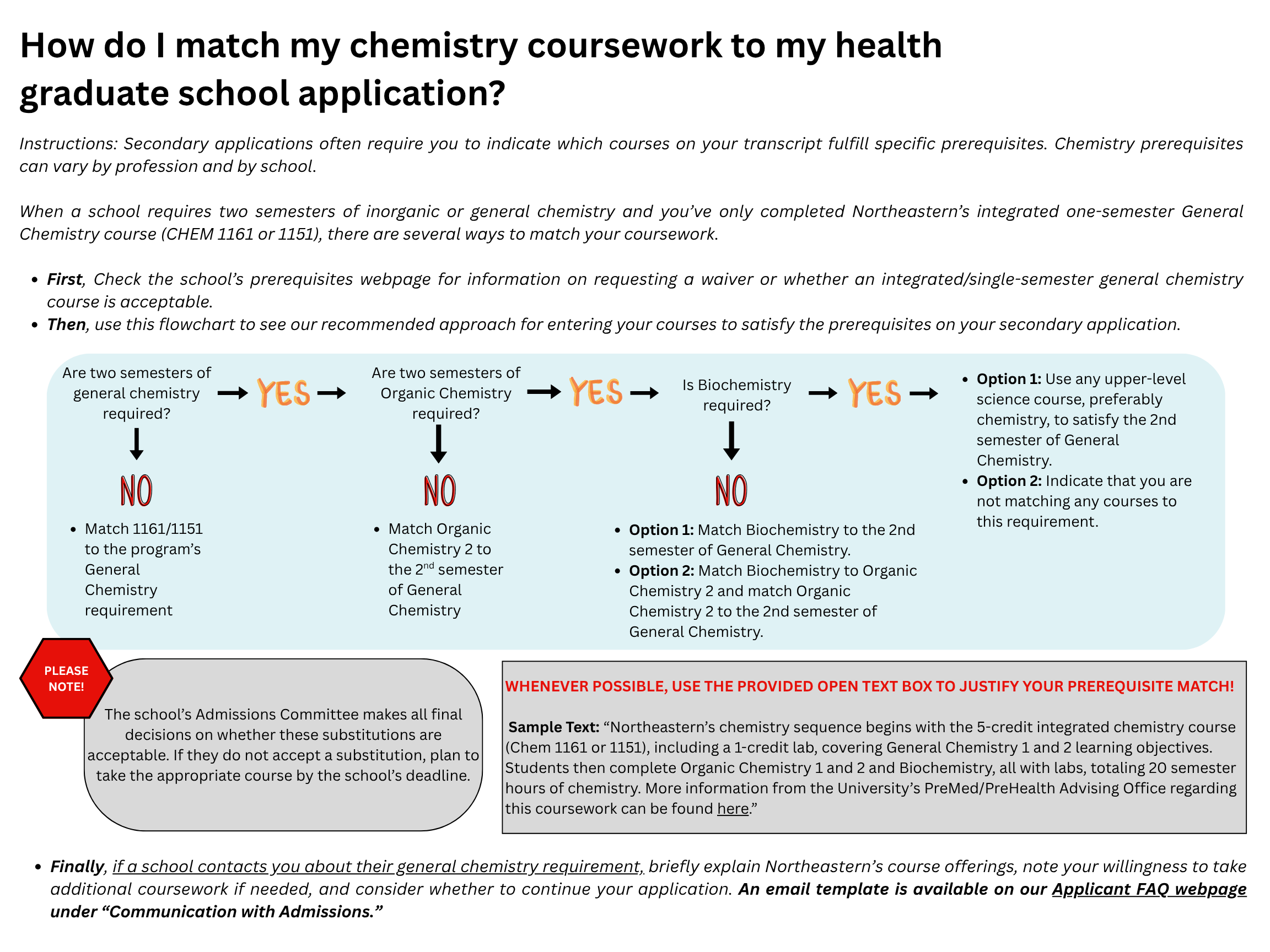
Some secondary applications ask applicants to identify which courses on their transcript fulfill specific prerequisite requirements. Because course titles and curricular structures vary across institutions, focus on course content rather than looking for an exact title match when selecting your coursework.
This is especially important for Northeastern courses that may differ from traditional prerequisite sequences, such as Integrated General Chemistry (CHEM 1161/1162). Review the Northeastern University Coursework and Applicant FAQ webpages for course descriptions, syllabi, and institutional statements that may help you determine and explain appropriate course equivalents.
Use your best judgment when matching coursework to a program’s requirements. Admissions committees make the final determination about whether a course fulfills a prerequisite.
The flowchart below demonstrates how a Northeastern applicant might approach matching coursework to prerequisite requirements for General Chemistry coursework:
Some health professional programs may request additional documentation or clarification about your Northeastern academic or student record as part of the secondary application process. The resources below can help you respond to common requests.
Curriculum Documentation
Some programs may request clarification about Northeastern’s curriculum, particularly the Integrated General Chemistry (CHEM 1161/1162) course, Basic Clinical Skills for the Healthcare Professional as a substitute for Medical Terminology, or discipline-specific statistics courses.
Institutional letters and supporting documentation explaining Northeastern’s unique coursework are available on our Northeastern University Coursework webpage.
Our Applicant FAQ also provides guidance to help applicants address questions from admissions about select Northeastern courses and curricular structures.
Letters of Good Standing
If a program requests a letter confirming your academic standing at Northeastern, direct documentation requests to your Academic Advisor in your home college. If additional support is needed, please contact PMPH@northeastern.edu.
Institutional Action Documentation
If you reported an institutional action and a program requests official documentation or verification from Northeastern, direct documentation requests to OSCCR: Authorization for Release of Information Form