Present Your Research!
Welcome to RISE 2026
Interested in presenting at RISE 2026? Check out the “Presenters” tab below.
RISE is the showcase for research and creative projects being undertaken by everyone at Northeastern: learners from every year of study, every major, every campus. Undergraduate and graduate students are invited to share work that will be presented live as a poster talk on RISE Expo day or as a talk during one of our presentation sessions.
Presenters
If you created it or discovered it in the last year April 2025-April 2026, you can share it at RISE.
RISE is a chance to:
- Share game-changing innovation, path-breaking scholarship, world-shaping creativity, and your entrepreneurial spirit
- Connect with thinkers, doers, creators, and impact makers from across the disciplines and around the world
- Celebrate the best of Northeastern
Undergraduate and graduate students are invited to submit an abstract. Read the materials below (coming soon!) for instructions. Students whose abstracts are accepted will be asked to share a poster or present an oral presentation at RISE. Submissions are accepted and reviewed on a rolling basis.
There are two ways to present at RISE 2026. You may choose to share your work either as a poster during the poster session on April 9th, or as an 8-minute oral presentation during a panel on one of the oral presentation days (tentatively scheduled for April 8 and April 10.
When you submit your abstract (instructions below) you will select which method you would like to use to share your work.
- Abstract Submissions Open: January 9, 2026
- Abstract Submission Deadline: February 9, 2026 DEADLINE EXTENDED! Submit by February 16th, 11:55 PM ET
- Poster Submission Deadlines (further poster instructions below under “Step Two: Submitting Your Poster”):
- If you would like URF to cover the cost of printing your poster: March 9, 2026
- If you are assuming the cost of printing your own poster: April 3, 2026
- All posters printed by presenters independently must still be submitted to the online portal no later than April 3. In-person poster presentation slots are processed on a first-come first-served basis based on poster submission time, until our in-person event space reaches presenter capacity. We will inform all intended participants yet to submit a poster to URF when in-person capacity has been reached.
- All posters printed by presenters independently must still adhere to the RISE size standards. Any oversized posters that encroach on other presenters space will be removed from the Poster Expo.
- If you are presenting your poster only in the asynchronous virtual poster gallery: April 3, 2026
- RISE Oral Presentation Days (tentative): April 8 & April 10, 2026
- RISE 2026 Poster Expo: April 9, 2026
SUBMISSION DEADLINE EXTENDED! – Abstracts are due February 16th, 2026.
Follow the steps below to submit your abstract. Submissions will be evaluated on a rolling basis.
To submit an abstract for RISE, you must first create an account on the RISE Abstract system using your official Northeastern University email.
Some helpful tips as you begin the submission process:
- Please be sure to create your account with a @northeastern.edu email address, not a @huskey.neu.edu or personal account
- Please be sure not to include faculty mentors and post-docs as co-presenters.
- For group projects please only submit one abstract – never fear! You can list all your student collaborators as co-presenters!
- A presenter may only be the “primary presenter” of a single project. They can be listed as an additional co-presenter on other projects if relevant.
Remember
- Abstracts should focus on projects undertaken during the past year — from April 2025 until the present day. While projects do not need to be complete, substantial progress should be made.
- Your abstract can be a maximum of 100 words, and does not include citations, paragraphs, or footnotes.
- Your abstract title can be a maximum of 12 words. Please use MLA capitalization.
Review and Approval
- Once submitted, your abstract will be reviewed for human/animal subjects, intellectual property, and editorial content.
- You’ll be able to see approval decisions through the platform.
Have questions not answered here? Contact the office. We look forward to connecting with you!
Once your abstract has been approved, in the submission portal your abstract will have been moved into poster phase of submission and the submission status will be “Incomplete”. You will be able to add your poster and other required information to your submission, and submit it for review by the deadline.
You’ll create a poster that will serve as an introduction to your project. If you want URF to cover the cost of printing your poster (approximately $90), you need to submit it to our office by March 9. If you want to print your own poster, please send us a PDF by April 3 so we can include it in our virtual gallery. All posters printed by presenters independently must still be submitted to the online portal no later than April 3. In-person poster presentation slots are processed on a first-come first-served basis based on poster submission time, until our in-person event space reaches presenter capacity. We will inform all intended participants yet to submit a poster to URF when in-person capacity has been reached.
If you would like to utilize the RISE poster template which adheres to the required size of RISE posters, you can access it here: RISE_2026_Poster_Template_ Do_Not_Resize You do not have to use the poster template, as long as your poster adheres to the required poster size of 44×34.5 inches. The template is just a blank PPTX file that takes the guesswork out of correctly sizing your poster to the required dimensions. There is no required poster header for RISE 2026. The only requirement is adhering to the poster size requirements.
When uploading your poster, you will be asked to include b a .PDF version. Please upload a 1-page pdf file of your poster RISE team to reference, as well as to include in the poster gallery.
All posters, including those printed by presenters independently must adhere to the RISE size standards. Any oversized posters that encroach on other presenters space will be removed from the Poster Expo. Posters must be 44×34.5 inches.
In your poster, you should be sure to include these four themes:
- BACKGROUND, MOTIVATION, AND GOALS: Explain the core question, problem, or challenge guiding your research or creative endeavor project. Why have you chosen to work on this question, problem, or challenge? Situate your work within the context of your broader field. How have previous researchers, artists, entrepreneurs, etc. approached your question or problem? How does your work build upon theirs? Why does your work matter to people in your field—and to people outside it?
- PROCESS AND METHODS: Summarize what you did to address your guiding question, problem, or challenge and to execute your project. What approach did you adopt, and why?
- FINDINGS AND PRODUCTS: Highlight the main findings or creative products that emerged from your project.
- CONCLUSIONS AND NEXT STEPS: Identify the main conclusions of your project and discuss potential next steps for your research or creative work. What are the implications of your project for those in your field, and those outside it?
This can follow whatever format you like, but you need to be sure that it is within the approved size range (44″ x 34.5)
Again, be sure to add the title and primary mentor information as well as your undergraduate or graduate level on your poster.
- You should include your primary mentor as well as any additional mentors in the authorship section in the main poster body or in acknowledgments.
- Be sure to include all sources of funding for the project
- Be sure to include all collaborators in this portion as well. If you need to add student collaborators to your abstract, please share that information with us over email RISE@Northeastern.edu.
As you make your poster, here are a few important tips:
Just Right for RISE, Remember Your Audience: Again, RISE is an event for an educated, non-specialist audience. Your poster should be technical enough to excite an expert, but not so technical that someone outsideyour field will be turned off. The idea is to start a conversation where you can go into more detail, depending on your interlocutor. Focus on the most important question you want a viewer to understand.
Use Images and Figures, Avoid the Wall of Text (no more than 1000 words in your poster): There will be many posters at RISE and you’ll want your poster to stand out. Use large images and figures to attract visual attention. Every detail of your project should not be in the poster — the idea is that you will use the poster as a prop for more engaged conversation. So use some big images and headers to signpost for your viewer the main points of your project and where it is headed.
A good practice is to start with an image or figure that you think responds to the prompts in each of the four areas above — BACKGROUND, MOTIVATION, AND GOALS; PROCESS AND METHODS; FINDINGS and PRODUCTS; and CONCLUSIONS and NEXT STEPS — and then build the poster around those visuals.
Bigger Is Better: People will be walking by at a distance. Use large fonts, images, and figures at appropriate resolutions to make your poster easy to read. Use bullets, numbering, and headlines where appropriate.
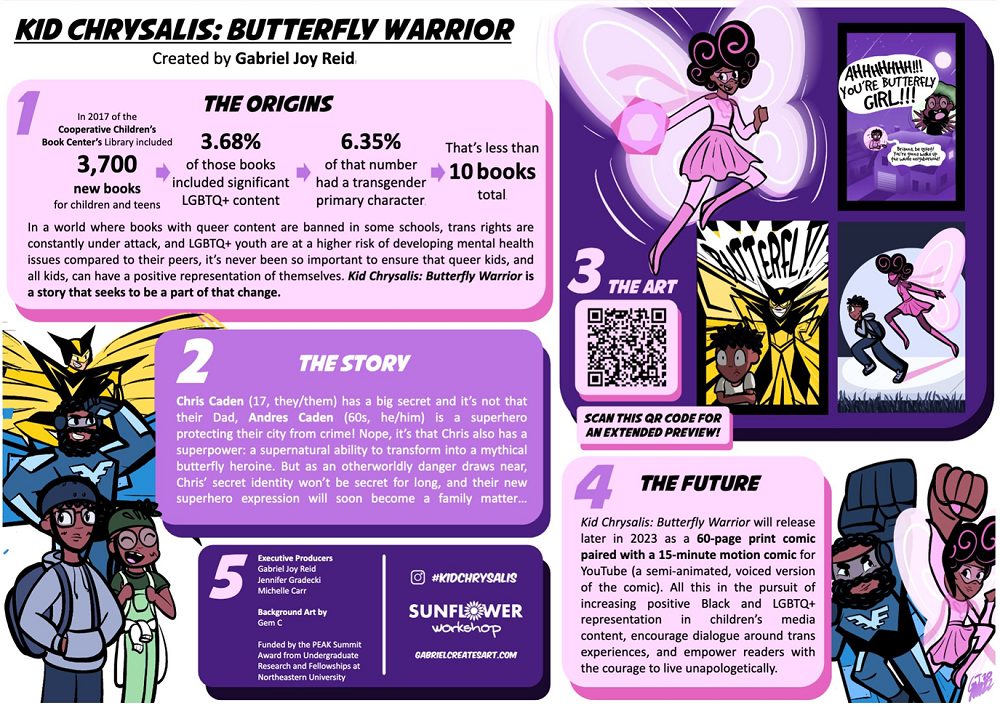
Poster design choices will vary dramatically based on the topic and field of the work being presented. However, if you are looking for insiration, feel free to peruse these examples:
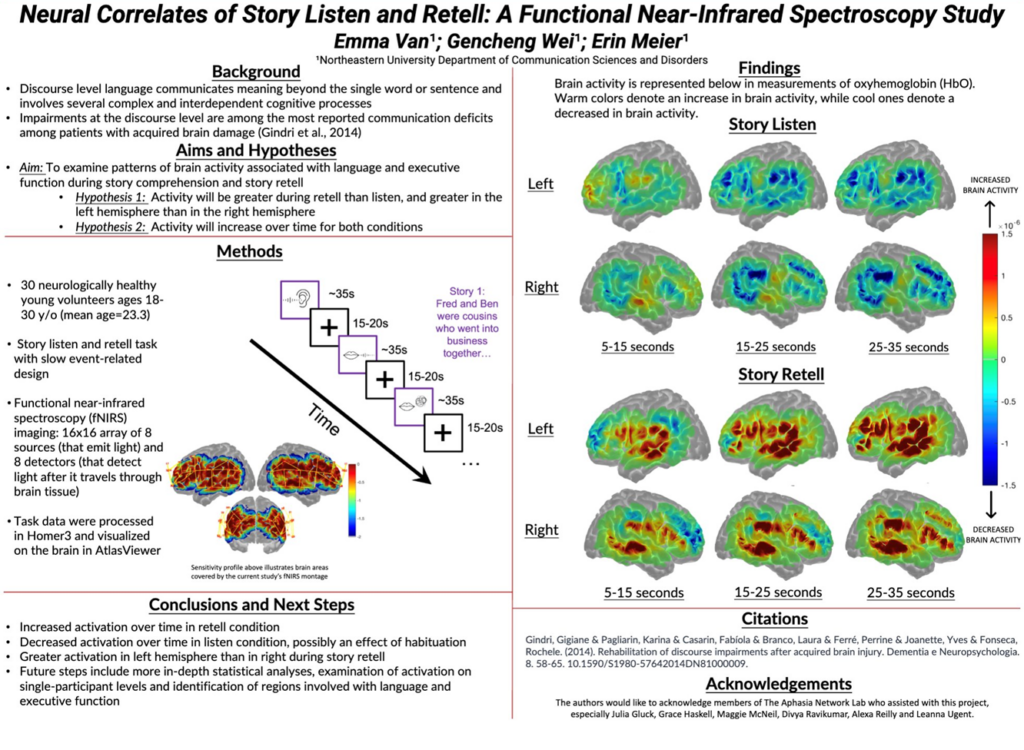
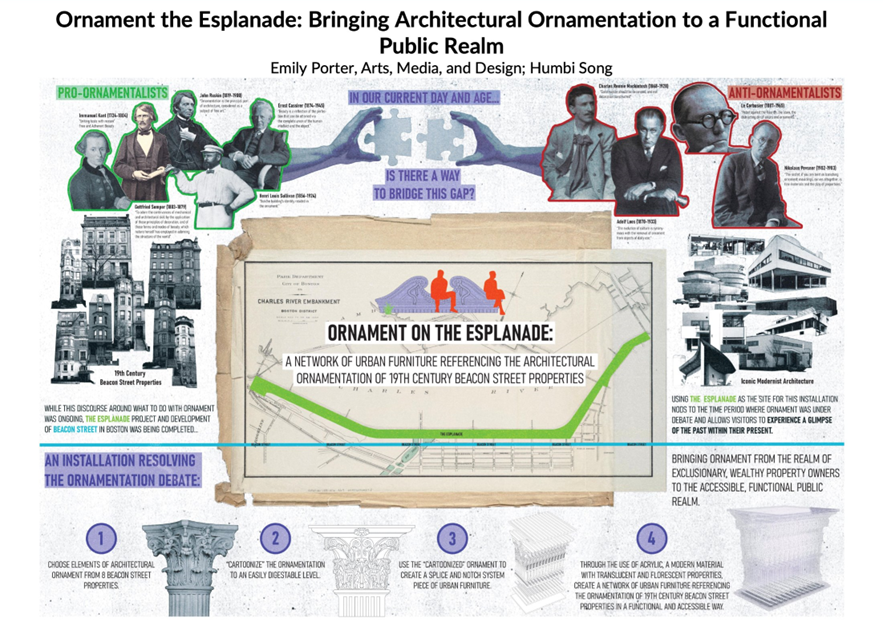
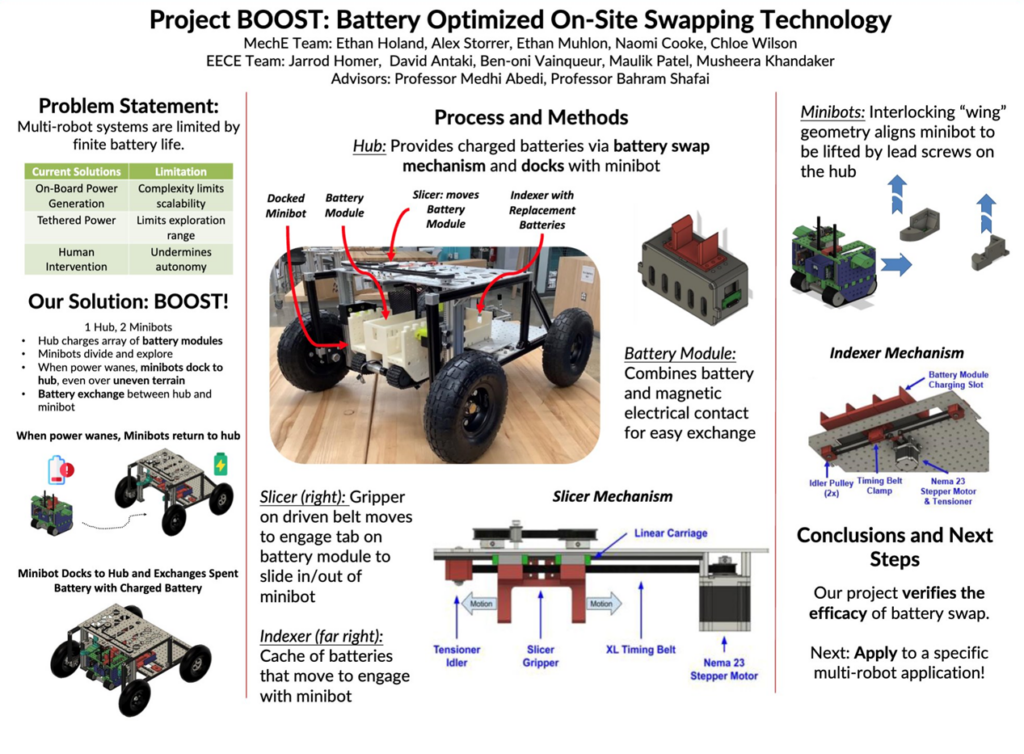

Other Advice for Creating a Poster
Congratulations on registering to present an oral presentation at RISE 2026! We are excited to hear about your work!
A few notes about expectations at this year’s conference:
- You will be placed on a panel with students who are conducting research in a similar field to yours. There will be 5-6 presenters on each panel, and panels will last one hour (40-45 min for presenters, followed by 10-15 minutes for questions).
- Each panel will be moderated by a peer or by URF staff, and presenters will receive a time warning at 2 minutes, 1 minute, and time.
- Slides are not required, but most presenters find them helpful. Please save your slides in an accessible cloud location so you can download them when you get to the room. You can also present off your own laptop if you have an HDMI connection.
Best practices for oral presentations:
- Practice, practice, practice! 8 minutes goes by a lot faster than you think. Be sure that you run through your slides before the day of the event to be sure that you are within the time frame.
- Remember your audience. The panels are arranged generally by topic, but are interdisciplinary, so you should be ready to present to a general academic audience.
- Don’t make your slides too text-heavy. People will be reading whatever you have on your slides; if you’re just reading your slides aloud, that will make your presentation boring. Your slides should have a sentence or two and images, but don’t just have your audience reading along.